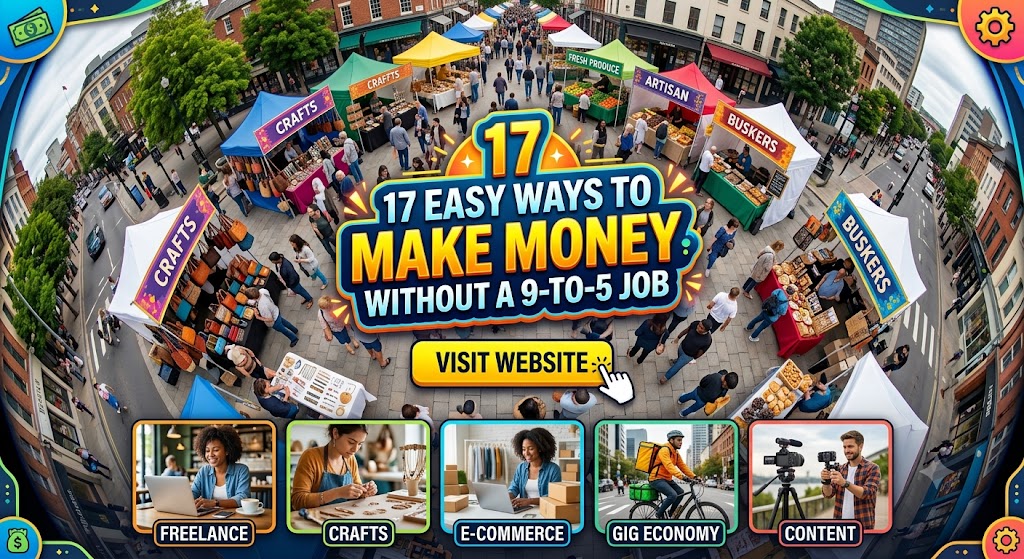
Escape the Cubicle: The Ultimate Guide to Earning Money Without a 9-to-5
The traditional 40-hour workweek is no longer the only path to financial security. In fact, for many, the “9-to-5” has become a symbol of stagnation rather than stability. We live in an era defined by the “Gig Economy,” the “Passion Economy,” and the “Creator Economy.” Today, your income is no longer tied to a desk, a boss, or a punch-clock. Whether you are looking to supplement your current income or replace your salary entirely, the opportunities to earn money on your own terms are more abundant than ever before.
This comprehensive guide explores the most effective, accessible, and scalable ways to build a life of financial freedom. We aren’t just talking about “beer money” apps; we are talking about legitimate business models and side hustles that can lead to a full-time income.
1. The Power of Freelancing: Selling Your Skills to the Highest Bidder
Freelancing is the most direct way to transition away from a 9-to-5. You are essentially taking the skills you already have—or skills you can learn quickly—and selling them as a service.
Writing and Content Creation
Businesses are starving for content. From blog posts and whitepapers to social media captions and email newsletters, the demand for the written word is astronomical.
- Copywriting: This is the art of writing to sell. If you can master the psychology of persuasion, you can charge thousands for a single sales page.
- Technical Writing: If you can translate complex jargon into simple instructions, software companies will pay a premium for your help.
- Ghostwriting: Many executives and influencers want to publish books or LinkedIn articles but don’t have the time. You provide the words; they provide the name.
Graphic Design and Visual Arts
If you have an eye for aesthetics, the digital world is your canvas.
- Logo and Branding: Startups need identities. A solid branding package can range from $500 to $5,000+.
- UI/UX Design: Designing how apps and websites look and feel is one of the highest-paid freelance niches today.
- Social Media Content: Businesses need a constant stream of Instagram stories, TikTok edits, and Pinterest pins.
Virtual Assistance (VA)
A VA is a remote executive assistant. Tasks can range from email management and scheduling to data entry and customer support. The key to making high money as a VA is specialization. A “General VA” makes $15/hour, but a “Tech VA” who knows how to set up automated sales funnels can make $50+/hour.
2. The Passive Income Dream: Making Money While You Sleep
Passive income is the holy grail of the non-traditional career. While it usually requires a significant upfront investment of time or money, the long-term rewards are unparalleled.
Digital Products
Unlike physical products, digital products have zero marginal cost. You create them once and sell them an infinite number of times.
- E-books: Self-publishing on Amazon Kindle Direct Publishing (KDP) allows you to reach a global audience without a publisher.
- Online Courses: If you know how to do something—be it gardening, coding, or playing the ukulele—you can package that knowledge into a video course on platforms like Teachable or Udemy.
- Templates and Printables: People pay for convenience. Budgeting spreadsheets, Canva templates, and organization planners are massive sellers on Etsy.
Affiliate Marketing
Affiliate marketing is the process of earning a commission by promoting other people’s products.
- Niche Websites: Build a blog around a specific topic (e.g., “Best Hiking Gear for Seniors”) and use affiliate links to earn a percentage of every sale made through your site.
- YouTube Reviews: Reviewing gadgets or software and putting links in the description is a tried-and-true method for generating passive monthly checks.
High-Yield Investing and Dividends
If you have savings, make your money work for you.
- Dividend Stocks: Invest in companies that pay out a portion of their earnings to shareholders.
- REITs (Real Estate Investment Trusts): This allows you to invest in real estate without having to manage a physical property. You earn a share of the rent collected.
3. The Sharing Economy: Monetizing Your Assets
You likely own things right now that could be generating cash. The sharing economy has turned every consumer into a potential service provider.
Real Estate Arbitrage and Hosting
You don’t need to own a mansion to make money on Airbnb.
- House Hacking: Rent out a spare room in your apartment or house.
- Rental Arbitrage: With a landlord’s permission, you can lease a property long-term and then list it on Airbnb for short-term stays, keeping the profit margin.
Vehicle Monetization
Your car is often your biggest depreciating asset. Turn it into a revenue stream.
- Turo: Think of it as Airbnb for cars. If you have a car that sits in the driveway, let others rent it.
- Wrap Advertising: Companies like Wrapify will pay you to wrap your car in an advertisement and simply drive your normal daily route.
Peer-to-Peer Lending
Platforms like Prosper or LendingClub allow you to act as the bank. You lend small amounts of money to individuals or small businesses in exchange for interest payments.
4. E-commerce: Building a Brand Without a Storefront
Selling physical goods has never been easier thanks to the “asset-light” models available today.
Dropshipping
In this model, you don’t hold any inventory. When a customer buys from your online store, the order is sent directly from the manufacturer to the customer. Your profit is the difference between the retail price and the wholesale cost.
Print-on-Demand (POD)
This is the ultimate low-risk business. You upload designs for T-shirts, mugs, or posters to platforms like Printful or Redbubble. The item is only printed and shipped when someone buys it. You never have to worry about unsold stock.
Amazon FBA (Fulfillment by Amazon)
You source products (often from manufacturers in China), ship them to Amazon’s warehouses, and Amazon handles the storage, shipping, and customer service. You focus on finding winning products and optimizing your listings.
5. Content Creation: Becoming a Digital Personality
The “Attention Economy” is real. If you can capture people’s attention, you can monetize it in a dozen different ways.
YouTube and Video Content
YouTube is the second-largest search engine in the world.
- AdSense: Once you hit 1,000 subscribers and 4,000 watch hours, YouTube pays you a share of the ad revenue.
- Sponsorships: Brands will pay you to mention their products in your videos.
- Merchandise: Once you have a loyal fanbase, selling branded apparel becomes a major income stream.
Newsletters
The “Substack Revolution” has proven that people will pay for high-quality, curated information delivered to their inbox.
- Paid Subscriptions: Charge a monthly fee for “insider” information or deep-dive analysis.
- Sponsorships: If you have 5,000+ engaged subscribers, companies will pay to be featured in your weekly blast.
Podcasting
While the market is crowded, the “niche” podcasting space is still wide open. Podcasts build a level of intimacy with listeners that other mediums can’t match, making it easier to sell high-ticket products or services.
6. Micro-Tasking and Low-Barrier Entries
If you need money today and don’t have a specific skill set yet, these options provide the quickest path to a few extra dollars.
Online Surveys and Focus Groups
While most survey sites pay pennies, high-end focus groups (like UserInterviews or Respondent.io) pay between $50 and $200 per hour for your opinion on new products or software.
Micro-Tasks
Platforms like Amazon Mechanical Turk (mTurk) or Clickworker involve doing small tasks that AI can’t do yet—like identifying objects in a photo or transcribing short audio clips. It won’t make you rich, but it’s an easy way to earn while watching TV.
User Testing
Sites like UserTesting.com pay you to navigate a website or app and speak your thoughts aloud. Companies use this feedback to fix bugs and improve user experience. Most tests pay $10 for 20 minutes.
7. Modern Arbitrage: Buying Low and Selling High
Arbitrage is one of the oldest ways to make money, and it works just as well today as it did 100 years ago.
Retail Arbitrage
This involves going to stores like Walmart, Target, or TJ Maxx, finding items on clearance, and reselling them on Amazon or eBay for their full market value.
Thrift Store Flipping
Vintage is in. Scouring Goodwill or yard sales for name-brand clothing, old electronics, or rare books and selling them on Poshmark, Depop, or eBay can be a highly lucrative “treasure hunt” business.
Furniture Refurbishing
If you are handy with a sander and paint, you can find free or cheap furniture on Facebook Marketplace, “upcycle” it with a modern look, and resell it for a 500% profit.
8. Specialized Consulting and Coaching
If you have spent years in a specific industry, your “brain” is your most valuable asset.
High-Ticket Coaching
People pay for results. If you can help someone lose 20 pounds, get a promotion, or fix their marriage, they will pay a premium. Coaching sessions can be done via Zoom, removing the need for an office.
B2B Consulting
Small businesses often struggle with things that larger corporations have mastered. If you know how to optimize a supply chain, manage a HR department, or run Google Ads, you can act as a fractional executive for several companies at once.
9. The Roadmap to Freedom: How to Transition
Quitting your 9-to-5 without a plan is a recipe for stress. Follow this roadmap to ensure a smooth transition.
Step 1: Identify Your “Anchor” Hustle
Choose one method from the list above that aligns with your skills and interests. This will be your primary focus. Don’t try to do five things at once; you’ll end up doing none of them well.
Step 2: Build a Financial Runway
Before you hand in your resignation, aim to have 3 to 6 months of living expenses saved. This “freedom fund” allows you to make decisions based on long-term growth rather than short-term desperation.
Step 3: The “After-Hours” Phase
Start your chosen hustle while you still have your 9-to-5. Use your evenings and weekends to build your portfolio, find your first three clients, or launch your first product. Once your side income reaches 50-75% of your day job income, the leap becomes much safer.
Step 4: Scale and Automate
As you start making money, look for ways to “buy back your time.” Hire a virtual assistant to handle administrative tasks or use software to automate your marketing. Your goal is to move from “working for yourself” to “owning a business.”
10. The Mindset Shift: From Employee to Owner
The biggest hurdle to earning money without a 9-to-5 isn’t a lack of opportunity; it’s the “Employee Mindset.”
An employee waits to be told what to do. An owner looks for problems and solves them. An employee trades time for money. An owner builds systems that decouple time from income.
The path of the modern earner is not a straight line. There will be months of high income and months of uncertainty. However, the trade-off is the ability to wake up when you want, work from where you want, and build a life that you don’t need a vacation from.
Conclusion: Your Journey Starts Today
The “easiest” way to earn money without a 9-to-5 is the one that you actually start. Whether it’s listing an old camera on eBay, sending your first freelance pitch, or recording a video for YouTube, the barrier to entry is lower than it has ever been in human history.
Stop waiting for the “perfect” time or the “perfect” idea. In the world of the new economy, execution is the only thing that matters. Choose your path, commit to the process, and reclaim your time. The exit from the cubicle is right in front of you—all you have to do is take the first step.