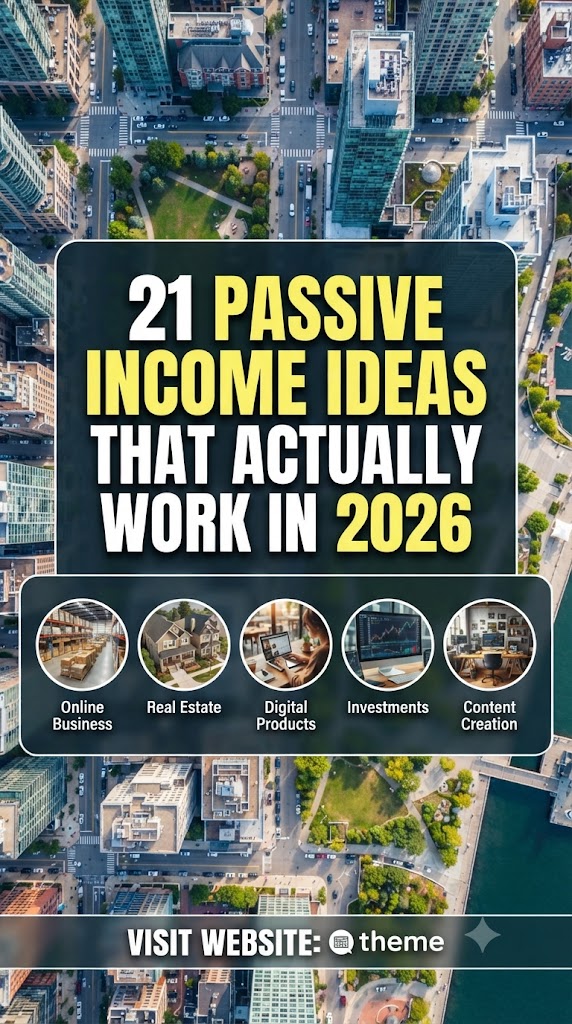
The Ultimate Guide to Financial Freedom: 21 Passive Income Ideas That Actually Work
The dream is universal: waking up in the morning, checking your phone, and seeing that you made money while you were asleep. For decades, this was a luxury reserved for the ultra-wealthy—those with massive stock portfolios or sprawling real estate empires. But the digital revolution has leveled the playing field. Today, anyone with a laptop, a small amount of capital, or a unique skill set can build streams of income that operate independently of their time.
Passive income is not a “get rich quick” scheme. It is the process of decoupling your time from your earnings. It requires a “front-loaded” effort—investing either time or money upfront—to create an asset that continues to generate cash flow in the future.
In this comprehensive guide, we will explore 21 proven passive income strategies, ranging from traditional investments to modern digital storefronts, to help you build a diversified portfolio of “money trees.”
1. Dividend Stocks: The Classic Wealth Builder
Dividend stocks are shares in companies that distribute a portion of their earnings to shareholders regularly. This is perhaps the oldest and most reliable form of passive income.
- How it works: When you own shares of companies like Coca-Cola, Johnson & Johnson, or Apple, they pay you a “dividend” (usually quarterly) just for holding the stock.
- The Strategy: Focus on “Dividend Aristocrats”—companies that have increased their dividend payouts for at least 25 consecutive years.
- The Upside: You benefit from both the cash payments and the potential appreciation of the stock price over time.
- The Passive Scale: 9/10. Once you buy the stock, the work is done.
2. Real Estate Investment Trusts (REITs)
If you want to invest in real estate but don’t want to deal with toilets, tenants, or trash, REITs are your best friend.
- How it works: A REIT is a company that owns, operates, or finances income-producing real estate. By law, they must distribute at least 90% of their taxable income to shareholders as dividends.
- The Strategy: You can buy REITs just like stocks through a brokerage account. You can choose specialized REITs that focus on healthcare, data centers, warehouses, or residential apartments.
- The Upside: High liquidity compared to physical real estate and a much lower barrier to entry (you can start with $100).
3. High-Yield Savings Accounts (HYSA) and CDs
While interest rates fluctuate, keeping your “emergency fund” or “dry powder” in a standard big-bank savings account is leaving money on the table.
- How it works: Online banks often offer significantly higher interest rates than traditional brick-and-mortar banks because they have lower overhead costs.
- The Strategy: Move your cash to an FDIC-insured high-yield account or a Certificate of Deposit (CD) if you don’t need the money for 6–12 months.
- The Upside: Zero risk (up to $250,000) and absolute liquidity. It’s the easiest way to make your money work for you without any effort.
4. Index Funds and ETFs
Instead of trying to pick the next “moonshot” stock, index fund investing allows you to own a piece of the entire market.
- How it works: An index fund, like one tracking the S&P 500, automatically invests your money into the 500 largest companies in the U.S.
- The Strategy: Set up an automatic monthly contribution (Dollar Cost Averaging). Over decades, the S&P 500 has returned an average of about 10% annually.
- The Upside: You aren’t betting on one company; you are betting on the growth of the global economy. It is the ultimate “set it and forget it” strategy.
5. Peer-to-Peer (P2P) Lending
P2P lending platforms allow you to act as the bank, lending your money directly to individuals or small business owners.
- How it works: Platforms like Prosper or LendingClub match investors with borrowers. You receive monthly payments that include both principal and interest.
- The Strategy: Diversify your investment by lending small amounts ($25–$50) to many different borrowers to mitigate the risk of default.
- The Upside: Often offers higher returns than traditional bonds or savings accounts.
6. Build a Niche Authority Blog
Blogging is far from dead; it has just evolved. A niche blog that solves specific problems can become a massive passive income engine through affiliate marketing and ads.
- How it works: You create high-quality, SEO-optimized content around a specific topic (e.g., “Sustainable Gardening” or “Mechanical Keyboards”).
- The Strategy: Use tools like SEMrush or Ahrefs to find low-competition keywords. Once you have traffic, apply for premium ad networks like Mediavine or AdThrive.
- The Upside: Once an article ranks on the first page of Google, it can bring in traffic and revenue for years with minimal updates.
7. Affiliate Marketing: The Middleman Strategy
Affiliate marketing involves promoting other people’s products and earning a commission for every sale made through your unique link.
- How it works: You don’t need to create a product, handle shipping, or deal with customer service. You simply bridge the gap between a problem and a solution.
- The Strategy: Leverage “High-Ticket” affiliate programs or “Recurring” programs (like software subscriptions) where you get paid every month the user stays active.
- The Upside: Very low overhead and unlimited scaling potential.
8. Create and Sell Online Courses
If you have a skill—be it coding, yoga, cooking, or Facebook ads—you can package that knowledge into a digital course.
- How it works: Record video modules, create worksheets, and host them on platforms like Teachable, Thinkific, or Udemy.
- The Strategy: Focus on a “transformation.” Don’t just teach “Photography”; teach “How to Master Manual Mode in 30 Days.”
- The Upside: You create the asset once, and you can sell it thousands of times. It is the epitome of high-leverage work.
9. Write and Publish E-books (Amazon KDP)
The gatekeepers of the publishing world are gone. Amazon Kindle Direct Publishing (KDP) allows anyone to become a published author.
- How it works: Write a book, design a cover (or hire someone on Fiverr), and upload it to Amazon.
- The Strategy: Non-fiction “How-to” books or “Low Content” books (like journals, planners, and coloring books) are excellent for passive income.
- The Upside: Amazon’s massive search engine does the marketing for you if you optimize your keywords correctly.
10. Start a YouTube Channel
YouTube is the second largest search engine in the world. While it requires a lot of work upfront, a successful channel is a 24/7 revenue generator.
- How it works: Once you reach 1,000 subscribers and 4,000 watch hours, you can earn money through Google AdSense.
- The Strategy: Focus on “Evergreen” content—videos that will be relevant 5 years from now (e.g., “How to Change a Tire” vs. “News of the Day”).
- The Upside: Beyond ads, you can earn through sponsorships, affiliate links, and selling your own merchandise.
11. Rent Out Your Extra Space (Airbnb)
You don’t need to own an entire second home to profit from real estate.
- How it works: Rent out a spare bedroom, a basement suite, or even your garage for storage.
- The Strategy: Use a professional photographer for your listing. High-quality photos can increase your booking rate by over 40%.
- The Upside: Real estate is a tangible asset that appreciates while providing monthly cash flow.
12. Turo: The “Airbnb for Cars”
If your car sits in the driveway for most of the week, it’s a liability. Turo turns it into an asset.
- How it works: You list your car on the Turo app, and locals or travelers rent it from you.
- The Strategy: Many people scale this by buying 3 or 4 reliable, mid-range cars (like Toyota Camrys or Honda Civics) specifically to rent out, creating a “mini-fleet.”
- The Upside: The earnings can often cover the car’s monthly payment, insurance, and maintenance, leaving you with pure profit.
13. Digital Templates and Printables (Etsy)
Etsy isn’t just for handmade crafts. It’s a goldmine for digital products.
- How it works: Design digital assets like wedding invitations, budget planners, resume templates, or Excel spreadsheets.
- The Strategy: When a customer buys your item, they receive a download link automatically. You never have to go to the post office.
- The Upside: Zero inventory costs and zero shipping hassles.
14. Stock Photography and Video
If you’re a skilled photographer or videographer, your hard drive is likely full of “passive income” waiting to be uploaded.
- How it works: Upload your high-quality photos and b-roll footage to sites like Shutterstock, Adobe Stock, or Getty Images.
- The Strategy: Focus on commercial themes—people in business settings, diverse groups, or specific technology—that bloggers and ad agencies need.
- The Upside: Each photo can be sold hundreds of times.
15. Create a SaaS (Software as a Service)
This is the most “difficult” but potentially most lucrative idea on this list.
- How it works: Identify a repetitive problem and build a software tool to solve it. This could be as simple as a Chrome extension or a complex project management tool.
- The Strategy: You don’t need to be a coder; you can hire developers on platforms like Upwork to build your MVP (Minimum Viable Product).
- The Upside: SaaS models usually involve monthly subscriptions, leading to highly predictable recurring revenue.
16. Licensing Music and Sound Effects
Musicians can earn royalties by licensing their tracks for use in commercials, YouTube videos, and films.
- How it works: Upload your tracks to libraries like AudioJungle, Epidemic Sound, or Pond5.
- The Strategy: Create “loops” and “stings” that are easy for video editors to use as background music.
- The Upside: Royalties can accumulate over years, especially if a track gets picked up for a popular medium.
17. Vending Machines and ATMs
This is a “phygital” (physical + digital) passive income play.
- How it works: You purchase a vending machine or ATM and place it in a high-traffic area (gyms, offices, laundromats).
- The Strategy: Success in this business is 90% location. Once the location is secured, you can hire someone to restock the machines or collect the cash, making it almost entirely passive.
- The Upside: Instant cash flow and a very tangible business model.
18. Print on Demand (POD)
POD is like dropshipping, but for custom-designed products.
- How it works: You create a design (or buy one) and upload it to platforms like Printful or Redbubble. When someone buys a shirt, mug, or hat with your design, the platform prints and ships it for you.
- The Strategy: Focus on trending niches or “micro-niches” (e.g., “Gifts for Left-Handed Accountants”).
- The Upside: No inventory risk. You only pay for the product after a customer has paid you.
19. Investing in Small Businesses (Mainvest)
You can now invest in local brick-and-mortar businesses—like breweries, bakeries, and gyms—without being an “accredited investor.”
- How it works: Platforms like Mainvest allow you to provide capital to small businesses in exchange for a share of their revenue (Revenue Sharing Notes).
- The Strategy: Diversify across multiple businesses to protect your capital.
- The Upside: You support local communities while earning a target return (often 10–25% total return).
20. Sell “Leads” to Local Businesses
Many local businesses (plumbers, roofers, landscapers) are great at their craft but terrible at marketing.
- How it works: You build a simple website ranking for terms like “Best Roofer in [City Name].” When people call the number on the site, the call is forwarded to a local contractor who pays you a fee for the lead.
- The Strategy: This is known as “Rank and Rent.” Once the site is ranking, it requires almost zero maintenance.
- The Upside: High margins and very low competition in smaller geographic markets.
21. Create a Membership Site
If you have a community or a recurring set of information to provide, a membership site is the ultimate stability.
- How it works: Users pay a monthly fee (e.g., $19/month) to access exclusive content, a community forum, or monthly coaching calls.
- The Strategy: Use platforms like Patreon or Circle.so to manage the community. The key is “stickiness”—providing enough value that people never want to cancel.
- The Upside: 100 members at $20/month is a steady $2,000/month. The math of memberships is incredibly powerful.
The Secret Sauce: Which One Should You Choose?
The biggest mistake people make is trying to start five of these at once. Passive income requires a significant “activation energy.” To be successful, you must:
- Assess Your Resources: Do you have more money or more time?
- If you have money, focus on Dividend Stocks, REITs, or buying an existing business.
- If you have time, focus on Content Creation, YouTube, or Digital Products.
- Focus on One Stream: Get your first stream to $100 a month before starting the second. The “shiny object syndrome” is the killer of passive income dreams.
- Think Long-Term: Passive income is a marathon, not a sprint. A blog might take a year to earn its first dollar, but three years later, it could be paying your mortgage.
The Reality Check: “Passive” is a Spectrum
It is important to remember that almost no income is 100% passive forever.
- Real estate requires occasional management or oversight of a manager.
- Dividend portfolios need annual rebalancing.
- Blogs need occasional content updates to stay relevant in Google.
The goal is to move from Active Income (trading 1 hour for $X) to Passive Income (where 1 hour of work today can pay you for 100 hours in the future).
Final Thoughts
The path to financial freedom isn’t about finding a “magic button.” It’s about building assets. Every dollar you invest in a dividend stock, every article you write for a niche site, and every digital template you design is a “digital soldier” working for you while you sleep.
Start today. Pick one idea from this list that resonates with your skills and interests. Commit to it for six months. In a few years, your future self will thank you for the freedom you built.
Which of these 21 ideas will you start today? The best time to plant a tree was 20 years ago. The second best time is now.