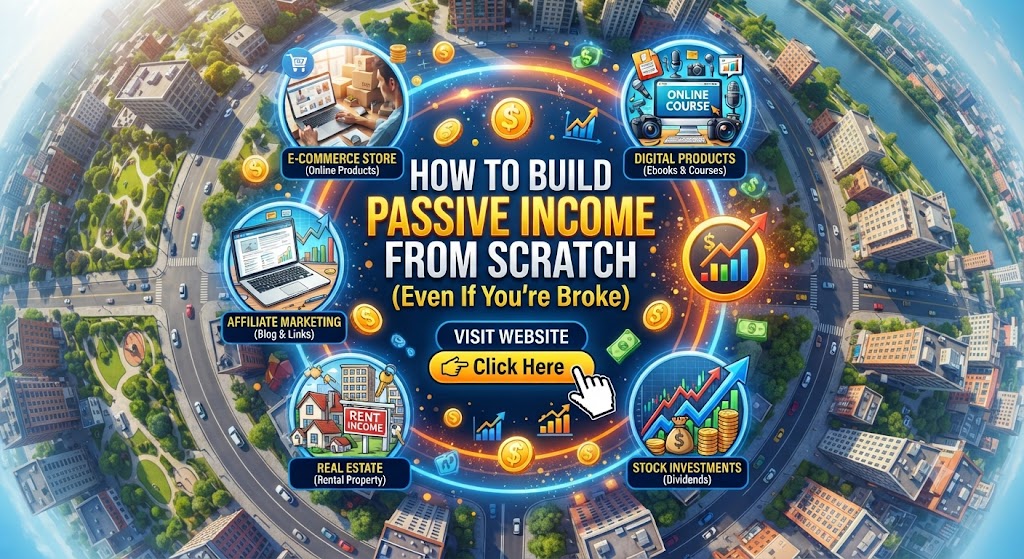
How to Build Passive Income From Scratch
The dream is iconic: waking up, checking your phone, and seeing that you made money while you were asleep. For decades, this was a luxury reserved for the ultra-wealthy—those with massive inheritance or real estate empires. Today, the landscape has shifted. The digital revolution has democratized wealth creation, allowing anyone with a laptop and a dose of discipline to build “money machines” from nothing.
The term “passive” refers to the output, not the input. To build a stream of income that flows without your active daily presence, you must front-load the work. You are either investing significant amounts of time or significant amounts of money. If you are starting from scratch, you will likely be investing time to create the capital that you can later invest.
Part 1: The Philosophy of the Passive Income Mindset
Before you pick a strategy, you must understand the mechanics of how wealth is built. Most people are stuck in the “Time-for-Money” trap. They trade one hour of their life for a set number of dollars. While this is necessary for survival, it is a linear path that has a hard ceiling.
The Decoupling of Time and Wealth
Passive income is the process of decoupling your earning potential from your clock. To do this, you must build or buy Assets.
- An Asset: Something that puts money in your pocket (Rental property, stocks, a YouTube channel).
- A Liability: Something that takes money out of your pocket (Your car, your personal home, your Netflix subscription).
The Three Pillars of Leverage
To move from active to passive, you must use one of the three forms of leverage:
- Capital (Money): Using money to make more money (Investing).
- Labor (People): Hiring others to run systems for you.
- Code and Content (Media): Building digital assets that work 24/7 without marginal costs of reproduction.
If you are starting from scratch, Code and Content will be your greatest allies.
Part 2: Tier 1 Strategies – High Effort, Low Capital
Best for: Beginners with more time than money.
1. The Content Authority Model (Blogging & SEO)
Blogging is far from dead; it has simply evolved. By creating a “niche site” that answers specific questions or solves problems, you can attract organic traffic from Google.
- The Mechanism: You write high-quality articles optimized for Search Engine Optimization (SEO). Once the article ranks on the first page of Google, it brings in visitors every day.
- Monetization:
- Display Ads: (Mediavine, AdThrive) Pay you for every 1,000 views.
- Affiliate Marketing: Recommending products and taking a commission on sales.
- The “Scratch” Approach: Start with a $10 domain and $5/month hosting. Focus on a “micro-niche”—instead of “fitness,” focus on “kettlebell training for men over 50.”
2. The YouTube “Faceless” Channel
You don’t need to be a celebrity to make money on YouTube. Many of the most profitable channels use stock footage, voiceovers, and animations.
- The Mechanism: Create evergreen content (tutorials, explainers, or documentaries). YouTube’s algorithm works as your 24/7 sales team, suggesting your videos to new viewers years after you upload them.
- The Passive Factor: Once a video is “indexed” and liked by the algorithm, it generates AdSense revenue for years with zero additional work.
3. Digital Product Ecosystems
Digital products are the holy grail of passive income because they have a zero marginal cost. Whether you sell 1 copy or 10,000, your cost remains the same.
- E-books and Guides: Use Amazon Kindle Direct Publishing (KDP). You write the book once, and Amazon handles the distribution, payment, and delivery.
- Online Courses: Platforms like Teachable or Udemy allow you to package your expertise into a video course.
- Templates and Tools: Sell Notion templates, Excel spreadsheets for budgeting, or Canva design templates on Etsy.
Part 3: Tier 2 Strategies – Medium Capital, Medium Effort
Best for: Those who have built some savings and want to accelerate growth.
1. Dividend Growth Investing (DGI)
Dividend investing is the closest thing to a “magic” money tree. When you buy shares of a dividend-paying company (like Coca-Cola or Realty Income), they literally pay you a portion of their profits every quarter just for owning the stock.
- The Strategy: Focus on “Dividend Aristocrats”—companies that have increased their dividends for 25+ consecutive years.
- The Power of DRIP: Use a Dividend Reinvestment Plan (DRIP). Instead of spending the cash, the brokerage automatically buys more shares, which then produce more dividends. This is the definition of a compounding snowball.
2. High-Yield Savings & CDs (The Safety Net)
While not the most exciting, in a high-interest-rate environment, putting your “emergency fund” into a High-Yield Savings Account (HYSA) or a Certificate of Deposit (CD) is effortless passive income. It ensures your money isn’t losing value to inflation while you plan your next big move.
3. Peer-to-Peer (P2P) Lending
Platforms like Prosper or LendingClub allow you to act as the bank. You lend small amounts of money to individuals or small businesses in exchange for interest payments.
- Risk Management: Diversify by lending $25 to hundreds of different people rather than $2,500 to one person.
Part 4: Tier 3 Strategies – High Capital, Low Effort
Best for: Scaling existing wealth into true financial freedom.
1. Real Estate Crowdfunding & REITs
Physical real estate is great, but it’s rarely “passive” (tenants, toilets, and trash). Real Estate Investment Trusts (REITs) or crowdfunding platforms like Fundrise allow you to own a piece of commercial or residential empires without ever picking up a hammer.
- Why it works: You get the benefits of real estate (dividends and appreciation) with the liquidity of a stock.
2. Vending Machines and ATMs
This is “unconventional” real estate. You are essentially renting out a few square feet of space in a high-traffic area.
- The Hustle: You buy a machine, find a location (gyms, laundry mats, hotels), and stock it.
- Making it Passive: Once you have 5–10 machines, you hire a part-time driver to restock and collect the cash, leaving you with the profit.
3. Buying an Existing Content Business
Instead of starting a blog from scratch and waiting two years for traffic, you can buy one. Sites like Empire Flippers or Flippa list profitable websites, Amazon FBA businesses, and SaaS apps.
- The Advantage: You are buying “validated” cash flow. You skip the “struggle phase” and go straight to the “optimization phase.”
Part 5: The Step-by-Step Roadmap from $0 to $5,000/Month
If you are starting today with zero dollars and zero assets, here is your five-year plan.
Year 1: The Foundation (The Sweat Equity Phase)
- Goal: Generate your first $100 of “extra” income.
- Action: Choose one “Tier 1” strategy. Let’s say you choose a niche blog. Spend 10 hours a week writing 2–3 high-quality articles.
- Focus: Do not look at the money. Focus on “Input Metrics” (articles published, keywords ranked).
Year 2: The Proof of Concept
- Goal: Reach $500/month.
- Action: Your content should start gaining traction. Start implementing affiliate links and display ads.
- The Pivot: Take every single dollar earned from this side hustle and reinvest it. Do not buy a new phone. Buy a better keyword research tool or hire a freelance writer to double your output.
Year 3: Diversification
- Goal: Reach $1,500/month.
- Action: Your first asset is now stable. Now, take a portion of those profits and move them into “Tier 2.” Start a Dividend Growth Portfolio.
- The Snowball: You now have two streams: your blog (active-passive) and your dividends (purely passive).
Year 4: Systematization
- Goal: Reach $3,000/month.
- Action: Hire a Virtual Assistant (VA) to handle the day-to-day operations of your content business (uploading, formatting, social media). Your “active” work should drop from 10 hours a week to 2 hours of “management.”
Year 5: The Wealth Flywheel
- Goal: Reach $5,000+/month.
- Action: Use your large surplus of cash to enter “Tier 3.” Invest in a REIT or buy a small, existing profitable website to add to your portfolio. At this point, the interest and dividends alone are likely covering a significant portion of your living expenses.
Part 6: The Pitfalls That Kill Passive Income Dreams
Most people fail not because they lack the ability, but because they fall into these common traps:
- The “Shiny Object” Syndrome: Switching from blogging to dropshipping to crypto every three months. Passive income requires “compounding,” and compounding requires time. Pick one lane and stay in it for at least 12 months.
- Underestimating Maintenance: No income is 100% passive forever. Blogs need software updates; rental properties need repairs; even index funds need annual rebalancing. Factor in “maintenance time” to your schedule.
- High-Risk “Passive” Scams: If someone promises you 20% monthly returns with “no risk,” it is a Ponzi scheme. Real passive income generally yields 5–15% annually for capital-heavy investments, or higher for sweat-equity businesses.
- Taxes: People forget that Uncle Sam wants his cut. Passive income is often taxed differently than earned income. As you grow, consult a tax professional to set up an LLC or S-Corp to protect your earnings.
Part 7: Tools of the Trade
To build a passive empire, you need the right “Digital Stack.”
- For Content: WordPress (CMS), Ghost (Newsletters), Canva (Design), ChatGPT/Claude (Content Assistance).
- For Investing: Vanguard or Fidelity (Low-cost Index Funds), Schwab (Dividend reinvestment), Fundrise (Real Estate).
- For Organization: Notion (Project Tracking), Trello (Workflow), Slack (Communicating with VAs).
- For Automation: Zapier (Connects different apps to automate tasks).
Part 8: Conclusion – The Psychological Freedom
The ultimate goal of building passive income isn’t just about buying luxury cars or traveling the world—though those are nice perks. It’s about Time Sovereignty.
When your basic living expenses (rent, food, insurance) are covered by assets you own, you are effectively “free.” You no longer work because you have to; you work because you want to. This shift in mindset leads to better health, better relationships, and ironically, more creative ideas that often lead to even more income.
Building passive income from scratch is a marathon, not a sprint. It starts with one article, one share of stock, or one digital template. The best time to start was ten years ago; the second best time is today.
Stop trading your life for a paycheck. Start building the systems that will eventually set you free. The road is long, the work is hard at the beginning, but the destination—complete financial independence—is worth every ounce of effort.