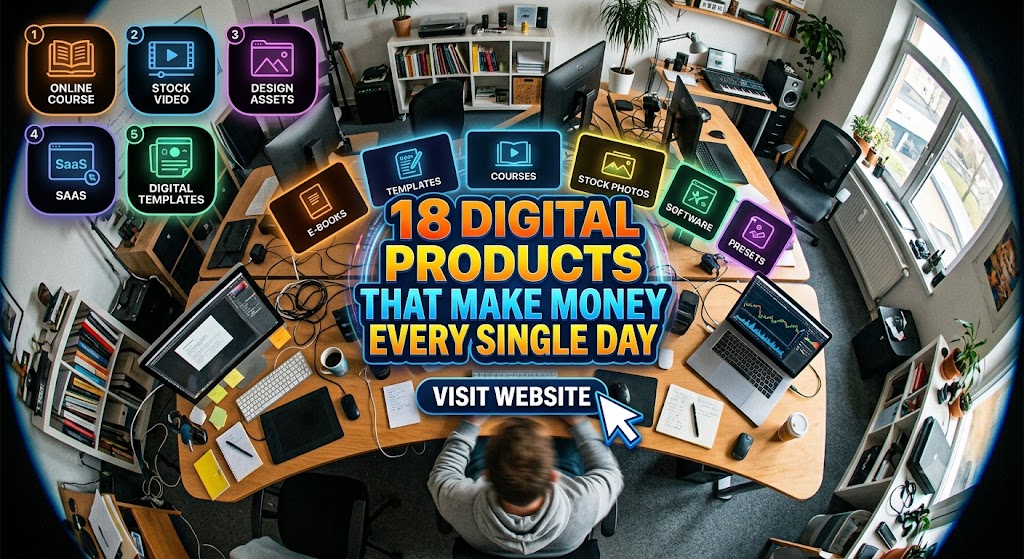
The Digital Gold Mine: 18 Digital Products That Sell Every Day
The era of the “starving artist” is officially over. We are currently living in the most lucrative period in human history for creators, thinkers, and problem solvers. The barrier to entry for starting a global business has dropped from millions of dollars in infrastructure to a simple laptop and an internet connection.
Digital products are the “holy grail” of business models. Unlike physical goods, they require no inventory, no shipping costs, and no warehouses. You create them once, and you can sell them an infinite number of times while you sleep. This is the essence of “passive income,” though the initial effort is anything but passive.
If you are looking to break free from the 9-to-5 grind or simply want to build a secondary revenue stream that works 24/7, here are 18 digital products that have proven demand and sell every single day.
1. Online Courses and Masterclasses.
- Why it sells: High perceived value. People are willing to pay for a transformation.
- The Hook: Don’t just teach “Marketing.” Teach “How to Scale a Skincare Brand to $10k/Month Using TikTok Ads.”
- Best Platforms: Teachable, Kajabi, Udemy, or Thinkific.
2. E-books and Comprehensive Guides
The e-book market is a multi-billion dollar industry that continues to grow. Whether it’s a self-help guide, a technical manual, or a collection of vegan recipes, e-books are the easiest digital products to produce.
- 1. Printable Planners
- Create daily, weekly, or monthly planners that help people stay organized. Printables are easy to design, require no inventory, and can generate passive income through marketplaces like Etsy.
- 2. Ebooks
- Share your expertise in a digital book covering topics such as business, fitness, finance, or hobbies. A well-written ebook can continue earning sales for years.
- 3. Online Courses
- Teach a valuable skill through video lessons or downloadable materials. Courses on AI, coding, marketing, and personal development are consistently in demand.
- 4. Canva Templates
- Design ready-to-use templates for social media, presentations, resumes, or business documents. These products are popular with creators and small business owners.
- 5. Website Themes
- Develop professional website themes for WordPress, Shopify, or other platforms. Businesses are always looking for attractive, customizable designs.
- 6. Stock Photos
- Sell high-quality images that bloggers, marketers, and companies can use in their content. Evergreen photo collections can produce recurring revenue.
- 7. Digital Art Prints
- Create printable wall art, illustrations, or typography designs. Customers can instantly download and print them at home.
- 8. Resume Templates
- Professionally designed resumes and cover letter templates help job seekers stand out. This is a high-demand niche with year-round sales.
- 9. Spreadsheet Templates
- Offer Excel or Google Sheets templates for budgeting, project management, business tracking, or financial planning.
- 10. Social Media Templates
- Businesses and influencers constantly need eye-catching Instagram, Facebook, Pinterest, and LinkedIn post templates to save time.
- 11. Budget Planners
- Digital budgeting tools help users manage expenses, savings, and debt. These products are especially popular with personal finance audiences.
- 12. Digital Journals
- Create guided journals for gratitude, productivity, goal setting, or mental wellness that customers can use on tablets or print at home.
- 13. Lightroom Presets
- Photographers and content creators buy presets to edit photos quickly while maintaining a consistent visual style.
- 14. Business Forms
- Invoice templates, contracts, proposals, and client onboarding documents are valuable time-saving resources for freelancers and entrepreneurs.
- 15. Printable Worksheets
- Educational worksheets for kids, students, and teachers remain one of the best-selling digital products across multiple marketplaces.
- 16. Notion Templates
- Productivity enthusiasts love Notion dashboards for task management, budgeting, habit tracking, and business organization.
- 17. Digital Stickers
- Design stickers for digital planners and note-taking apps like Goodnotes. Creative sticker packs have strong repeat purchase potential.
- 18. Music, Sound Effects & Audio Files
- Produce royalty-free music, podcast intros, sound effects, or meditation audio that creators can license for their projects.
- These 18 digital products have low startup costs, require no physical inventory, and can generate passive income long after they’re created. By focusing on quality, solving real customer problems, and marketing effectively, you can build a digital product business that earns sales every day.
3. Notion Templates
Notion has become the go-to productivity tool for millions of people, but most users find the “blank slate” intimidating. They want pre-built systems that organize their lives, businesses, or content schedules.
- Why it sells: It saves time. Users pay for the organization and workflow you’ve already figured out.
- The Hook: Create niche templates like “The Ultimate Real Estate Agent CRM” or “The Student Exam Tracker.”
- Best Platforms: Notion Template Gallery, Gumroad, and Etsy.
4. Adobe Lightroom Presets
With the rise of Instagram and the “influencer aesthetic,” everyone wants their photos to look professional without spending hours in editing software. Presets allow users to apply a professional look to their photos with one click.
- Why it sells: High visual appeal and instant gratification.
- The Hook: Target specific moods—”Moody Dark Interiors,” “Summer Beach Glow,” or “Vintage Film Look.”
- Best Platforms: Creative Market, Etsy, and FilterGrade.
5. Website Themes and Templates
Every new business needs a website. However, hiring a developer costs thousands. Website templates (for Shopify, WordPress, Squarespace, or Framer) provide a middle ground: professional design at a fraction of the cost.
- Why it sells: Essential for business infrastructure. High demand as more people start side hustles.
- The Hook: Focus on a niche, like “High-Conversion Shopify Themes for Jewelry Brands.”
- Best Platforms: ThemeForest, Creative Market, and Framer Marketplace.
6. Stock Photography
In a content-heavy world, businesses, bloggers, and news outlets need high-quality imagery daily. If you have a decent camera or even a high-end smartphone, you can monetize your photos.
- Why it sells: Constant demand for fresh content to avoid copyright issues.
- The Hook: Focus on “Authentic Lifestyle” or “Corporate Diversity” photos rather than cheesy, staged stock photos.
- Best Platforms: Shutterstock, Adobe Stock, and Getty Images.
7. Digital Planners and Journals
The “iPad Productivity” trend has exploded. People are ditching paper for digital planners used in apps like GoodNotes or Notability. These products mimic the feel of a real planner but with digital perks like hyperlinks and infinite pages.
- Why it sells: Habit-forming and visually satisfying.
- The Hook: Design planners for specific goals, like “The Manifestation Journal” or “The ADHD-Friendly Daily Organizer.”
- Best Platforms: Etsy and Creative Market.
8. Professional Resume Templates
The job market is competitive. Job seekers are desperate for any advantage that makes their application stand out to recruiters. A professionally designed, ATS-friendly (Applicant Tracking System) resume template is an easy sell.
- Why it sells: High utility. People are willing to spend money if it helps them make more money (by getting a job).
- The Hook: Offer a bundle—Resume + Cover Letter + LinkedIn Profile Guide.
- Best Platforms: Etsy and Gumroad.
9. Spreadsheet Templates (Excel and Google Sheets)
Many people run their businesses or personal finances on spreadsheets but lack the technical skill to build complex formulas. A well-designed, automated spreadsheet is a powerful tool.
- Why it sells: Solves a technical pain point. It’s a “tool,” not just “information.”
- The Hook: “The Automated Small Business Bookkeeping Spreadsheet” or “The Dividend Portfolio Tracker.”
- Best Platforms: Etsy and Gumroad.
10. Social Media Templates (Canva)
Small business owners know they need to post on social media, but they don’t have the time to design 30 posts a month. Canva templates allow them to drag and drop their photos into a professional design.
- Why it sells: Saves hours of design work.
- The Hook: Create niche-specific bundles like “30 Days of Instagram Posts for Yoga Instructors.”
- Best Platforms: Creative Market and Etsy.
11. Fonts and Typography
Graphic designers and brands are always looking for unique fonts to set their work apart. If you have an eye for calligraphy or vector design, creating a custom font can provide long-term royalties.
- Why it sells: Licensing for commercial use can be expensive and is highly sought after by agencies.
- The Hook: Create “Display Fonts” that are bold and unique for headlines.
- Best Platforms: MyFonts, Creative Market, and Envato Elements.
12. Video LUTs and Assets
As video content dominates the internet (YouTube, TikTok, Reels), the demand for video editing assets has skyrocketed. LUTs (Color grading presets for video), transitions, and motion graphics are in high demand.
- Why it sells: Video editing is hard; tools that make it easier are invaluable to creators.
- The Hook: “The Cinematic Vlogger Pack” or “Wedding Video Color Grading LUTs.”
- Best Platforms: Motion Array and VideoHive.
13. Music and Sound Effects (SFX)
Podcasters, YouTubers, and indie game developers need background music and sound effects that won’t get them flagged for copyright.
- Why it sells: Subscription-free audio is a major need for digital creators.
- The Hook: Focus on “Lofi Beats for Studying” or “Corporate Upbeat Background Music.”
- Best Platforms: AudioJungle, Pond5, and Epidemic Sound (if you are an artist).
14. 3D Models and Assets
With the growth of the Metaverse, VR, and indie gaming, 3D artists are finding a massive market for their models. Whether it’s architectural elements or character models, these assets are high-ticket items.
- Why it sells: Extremely high technical barrier to entry.
- The Hook: Create “Modular Kits” where assets can be snapped together to build an environment.
- Best Platforms: TurboSquid, CGTrader, and Unity Asset Store.
15. Printable Wall Art
This is a favorite on Etsy. You sell a high-resolution digital file, and the customer prints it themselves. No shipping, no damage during transit, and instant delivery.
- Why it sells: Affordable home decor.
- The Hook: Focus on trending styles like “Mid-Century Modern Abstract” or “Minimalist Botanical Line Art.”
- Best Platforms: Etsy.
16. Membership Sites and Paid Newsletters
Rather than a one-time sale, you sell access to a community or a recurring stream of information. This is the king of digital products because it creates predictable, monthly recurring revenue (MRR).
- Why it sells: People pay for community and curated, “insider” information.
- The Hook: “The Weekly Crypto Analysis Newsletter” or “A Community for Freelance Copywriters.”
- Best Platforms: Substack, Patreon, and Circle.
17. Email Marketing Sequences
Many business owners have an email list but don’t know what to write. You can sell pre-written “Welcome Sequences,” “Abandoned Cart Flows,” or “Launch Series” where they just fill in the blanks.
- Why it sells: Directly linked to revenue for the buyer.
- The Hook: “The 7-Day High-Conversion Sales Sequence for Course Creators.”
- Best Platforms: Gumroad and your own website.
18. Sewing and Crafting Patterns
The DIY and “Maker” movement is massive. People love to make their own clothes, plushies, or furniture. Digital patterns allow them to download the instructions and get started immediately.
- Why it sells: Hobbyists are some of the most dedicated and frequent spenders.
- The Hook: “The Beginner-Friendly Oversized Hoodie Pattern” or “Amigurumi Crochet Patterns for Animals.”
- Best Platforms: Etsy and Ravelry.
The Strategic Framework: How to Actually Sell Digital Products
Creating the product is only 20% of the battle. The other 80% is how you position it and get it in front of the right audience. To succeed in the crowded digital marketplace, you need a strategy.
Step 1: Identify a “Bleeding Neck” Problem
People don’t buy “products”; they buy solutions. A “bleeding neck” problem is something urgent. If someone is struggling to get a job, they need a resume template now. If a business is losing money on ads, they need a high-conversion landing page template now. The more urgent the problem, the easier the sale.
Step 2: Validate the Market
Before spending 100 hours creating a course, see if people actually want it.
- Look at Reviews: Go to Amazon or Udemy and look at the 3-star reviews of your competitors. What are people complaining about? What’s missing? That’s your gap.
- Check Keyword Volume: Use tools like Google Keyword Planner or Ahrefs to see how many people are searching for your product idea.
- Pre-sell: Create a landing page with a “Coming Soon” offer. If people are willing to put down money before it’s finished, you have a winner.
Step 3: Choose the Right Platform
- Marketplaces (Etsy, Amazon, Creative Market): These provide the traffic for you. You don’t need a huge social media following to start selling here, but you do have to compete on price and give the platform a cut.
- Self-Hosted (Shopify, Gumroad, Stan Store): You keep more of the profit and own the customer data (email addresses), but you are responsible for driving your own traffic through SEO or social media.
Step 4: The Power of Social Proof
Digital products are intangible. Customers can’t touch them before buying, which creates “purchase anxiety.” You overcome this with:
- Testimonials: Even if you have to give your product away for free to the first 10 people to get feedback.
- Previews: Show “inside” the course or provide a “sample” page of the e-book.
- Guarantees: A 30-day money-back guarantee lowers the risk for the buyer.
Step 5: Master the Traffic Funnel
You need a way to move people from “stranger” to “customer.”
- The Freebie (Lead Magnet): Give away a small part of your product for free (e.g., a “Free 3-Day Workout Plan”) in exchange for their email.
- Email Marketing: Once you have their email, nurture them with value and then pitch your paid product.
- Content Marketing: Use TikTok, Pinterest, or a Blog to show your expertise and link back to your product.
Why Most People Fail (And How to Be Different)
The failure rate in digital products isn’t due to a lack of skill; it’s due to a lack of persistence and poor positioning.
- They are too broad: They try to sell to “everyone.” If you sell to everyone, you sell to no one. Be the “Excel Guy for Dentists,” not just the “Excel Guy.”
- They ignore aesthetics: In the digital world, design is your “packaging.” If your product looks like it was made in 1995, people won’t trust it. Invest in professional design.
- They stop at one product: The real money is in the “product ladder.” Once a customer buys a $10 template from you, they are 10x more likely to buy a $200 course. Build an ecosystem, not just a single product.
Final Thoughts: The Time to Start is Now
The marginal cost of selling one more digital product is zero. This means that once you cover your initial time investment, your profit margins are essentially 100%. There is no other business on earth that offers that kind of leverage.
You don’t need to be a world-renowned expert to start. You just need to be two steps ahead of the person you are teaching. If you can solve a problem, save someone time, or provide entertainment, you have a product that can sell.
Pick one of the 18 products listed above that aligns with your skills. Commit to creating the best version of that product in the market. The digital economy is waiting—will you be a consumer or a creator?