
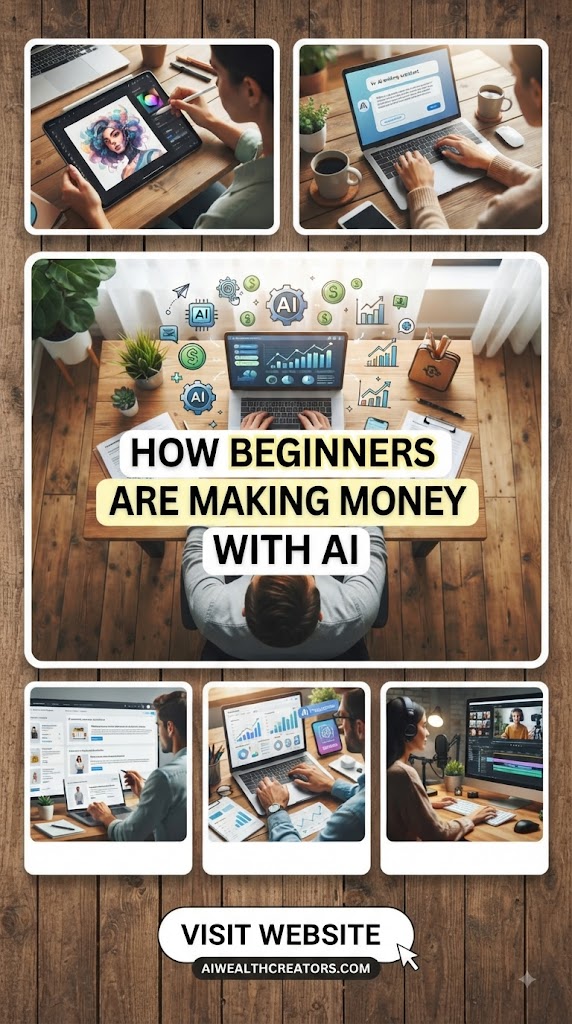
The AI Gold Rush: A Comprehensive Guide to How Beginners Are Making Money With AI in 2024
The barrier to entry for building a digital empire has never been lower. Just a few years ago, starting a software company required deep coding knowledge, launching a design firm required years of artistic training, and becoming a professional writer necessitated a lifetime of linguistic mastery.
Today, that paradigm has shifted. We are living in the “Age of the Prosumer,” where Artificial Intelligence (AI) acts as a force multiplier, allowing a single individual with a laptop to produce the output of a ten-person agency. This isn’t just hype; it is a fundamental shift in the global economy.
If you are a beginner looking to capitalize on this movement, you aren’t too late. In fact, you are right on time. This guide explores the most effective, battle-tested ways beginners are currently making money with AI, providing a roadmap for you to turn these tools into a sustainable income stream.
1. The Faceless YouTube Revolution: Automation at Scale
One of the most lucrative ways beginners are making money is through “Faceless YouTube Channels.” Traditionally, YouTube required a charismatic host, expensive cameras, and hours of manual editing. AI has eliminated these requirements.
How it Works:
Beginners are using a “stack” of AI tools to create high-quality video content without ever showing their faces or recording their own voices.
- Step 1: Niche Selection and Scripting: Using ChatGPT or Claude, creators generate scripts for high-CPM (Cost Per Mille) niches like finance, technology, or self-improvement. By feeding the AI specific prompts like “Write a 10-minute engaging YouTube script about the future of Quantum Computing,” you get a structured narrative in seconds.
- Step 2: Voiceover Generation: Tools like ElevenLabs have revolutionized voice synthesis. Beginners can now generate human-like narrations that are indistinguishable from professional voice actors.
- Step 3: Visuals and B-Roll: Instead of filming, creators use InVideo AI, Pictory, or Runway Gen-2. These tools can automatically find relevant stock footage or generate AI-driven visuals based on the script text.
- Step 4: Thumbnail Creation: Midjourney or Canva Magic Studio creates eye-catching, high-click-through-rate (CTR) thumbnails that draw viewers in.
The Profit Potential:
AdSense revenue is just the beginning. Successful faceless channels leverage their audience for affiliate marketing, selling digital products, or securing sponsorships. Beginners are seeing results by focusing on “evergreen” content that stays relevant for years.
2. AI-Powered Freelancing: Working Faster, Not Harder
Platforms like Upwork and Fiverr are currently undergoing a massive transformation. Beginners who embrace AI are outcompeting veterans by delivering higher quality work in a fraction of the time.
The “Multiplier” Strategy:
Instead of offering “writing” or “design,” beginners are offering “AI-Enhanced Solutions.”
- Copywriting: Using AI to generate 10 variations of an ad copy or a sales page. The human role shifts from “creator” to “editor and strategist.”
- Search Engine Optimization (SEO): AI tools like SurferSEO or Jasper analyze top-ranking content and tell the user exactly which keywords to include to rank on page one of Google. Beginners are charging $500–$2,000 per month for SEO management that is largely automated.
- Translation and Localization: AI can translate documents with 95% accuracy. Beginners are offering translation services, using AI for the heavy lifting and then manually proofreading for cultural nuances.
Why This Works:
Clients value speed and results. If you can deliver a high-converting landing page in 24 hours (with the help of AI) while a traditional copywriter takes a week, you win the contract every time.
3. The Rise of the “Prompt Engineer” and Prompt Selling
As businesses scramble to integrate AI into their workflows, they are discovering a major problem: they don’t know how to talk to the machines. This has given birth to the “Prompt Engineer.”
Monetizing Prompts:
A prompt is the instruction you give to an AI. A “bad” prompt gets a generic answer; a “great” prompt produces a masterpiece.
- PromptBase: This is a marketplace where individuals sell specific prompts for Midjourney, ChatGPT, and DALL-E. If you spend time perfecting a prompt that generates “Realistic Interior Design Photography” or “Professional Legal Contract Templates,” you can list it for $2.99–$9.99.
- Corporate Consulting: Beginners are teaching local small businesses how to use ChatGPT to automate their customer service emails or social media posts. You don’t need a computer science degree; you just need to know more than the business owner.
4. Digital Art and the Print-on-Demand (POD) Boom
The combination of AI art generators and Print-on-Demand services has created a goldmine for creative entrepreneurs.
The Workflow:
- Generation: Use Midjourney v6 to create stunning, high-resolution art. The key is finding a niche—think “Minimalist Japanese Tattoos,” “Vaporwave Aesthetic Posters,” or “Cute Kawaii Stickers.”
- Upscaling: Use tools like Gigapixel AI to increase the resolution so the images look crisp when printed on large canvases.
- Distribution: Upload these designs to Printful, Printify, or Redbubble. When a customer buys a shirt or a poster with your design, the POD service prints and ships it, and you keep the profit.
The Secret Sauce:
The most successful beginners in this space focus on micro-niches. Instead of “Cat T-shirts,” they create “T-shirts for Maine Coon owners who love Cyberpunk aesthetics.” AI allows you to create these hyper-specific designs in minutes.
5. Self-Publishing with AI: Amazon KDP
Amazon Kindle Direct Publishing (KDP) has become a favorite for AI-savvy beginners. This is particularly true in the “Low Content” and “Children’s Book” categories.
Children’s Books:
Writing and illustrating a children’s book used to take months. Now:
- Storyline: ChatGPT helps brainstorm a plot and writes the rhyming verses.
- Illustrations: Midjourney creates consistent characters across multiple pages (a previously difficult task that is now manageable with “Character Reference” features).
- Layout: Canva is used to assemble the book.
- Publishing: The PDF is uploaded to Amazon, where it is sold as a physical or digital book.
Educational Material:
Beginners are creating workbooks, journals, and study guides. By using AI to generate math problems, writing prompts, or language learning exercises, you can build a massive library of assets on the Amazon store that generate passive income monthly.
6. Developing Micro-SaaS and Chrome Extensions
You no longer need to be a coding wizard to build software. AI coding assistants like GitHub Copilot, Cursor, and ChatGPT (GPT-4o) can write functional code based on simple English instructions.
The Opportunity:
Beginners are identifying “micro-problems” and building “Micro-SaaS” (Software as a Service) solutions.
- Example: A Chrome extension that summarizes LinkedIn posts using AI.
- Example: A simple web app that generates personalized workout plans.
- Example: A tool that converts blog posts into Twitter threads.
By using “No-Code” platforms like Bubble or Softr in conjunction with AI-generated code snippets, beginners are launching functional software products in weekends rather than months.
7. AI Voice and Music Generation for Social Media
Short-form content (TikTok, Instagram Reels, YouTube Shorts) is the fastest way to gain organic reach. AI is now powering the audio side of this equation.
- AI Music: Tools like Suno AI or Udio allow users to generate full-length, high-quality songs from a text prompt. Beginners are creating “Lofi Hip Hop” channels on YouTube or selling royalty-free background music for other creators.
- Voice Cloning: Creators are using AI to clone their own voices to narrate content while they are sleeping, or creating “parody” content using famous (legally compliant) voice styles to drive engagement and viral growth.
8. Data Labeling and AI Tutoring
If you prefer a more “active” income rather than an entrepreneurial venture, the AI industry itself needs humans to help it learn.
- RLHF (Reinforcement Learning from Human Feedback): Companies like Remotasks or DataAnnotation.tech pay individuals to “grade” AI responses. You read two different AI answers and decide which one is better, more factual, or safer. This is a vital part of making AI smarter, and it pays surprisingly well—often between $15 and $40 per hour.
- Niche Expertise: If you are an expert in a field (like law or medicine), you can earn even more by helping train specialized AI models for those industries.
9. Building Custom GPTs for the GPT Store
OpenAI recently launched the GPT Store, allowing users to build their own customized versions of ChatGPT for specific tasks.
Examples of Profitable GPTs:
- The “Academic Researcher”: A GPT programmed to only cite peer-reviewed journals.
- The “Code Auditor”: A GPT specifically trained to find security flaws in Python code.
- The “Interior Design Assistant”: A GPT that takes a photo of a room and suggests furniture layouts based on specific styles.
While the monetization models are still evolving, building a popular GPT creates immense brand authority and can lead to high-ticket consulting or lead generation for your other businesses.
10. The Strategy for Success: How to Actually Make it Work
Knowing the tools is only 20% of the battle. The other 80% is execution. Here is how successful beginners are actually making money while others are just “playing” with the tools:
A. Focus on “Problem-Solving,” Not the Tool
Don’t start by saying “I want to use ChatGPT.” Start by saying “Small business owners are struggling to keep up with their Instagram DMs.” Then, use AI to build a solution for that specific problem.
B. The “Human-in-the-Loop” Principle
Purely AI-generated content is often bland and easily detectable. The highest-paid beginners use AI for the “first draft” (80% of the work) and then spend the remaining 20% adding human personality, fact-checking, and unique insights. This “Human-AI Hybrid” approach is what separates $100 earners from $10,000 earners.
C. Niche Down Until it Hurts
Don’t try to be an “AI Content Creator.” Be the “AI Content Creator for Sustainable Fashion Brands.” The more specific your niche, the less competition you have and the more you can charge.
D. Consistency is the Only Shortcut
The algorithms (Google, YouTube, TikTok) reward consistency. Using AI allows you to produce more content than ever before, but you still need to hit “publish” every single day.
11. Overcoming the Legal and Ethical Landscape
As a beginner, you must be aware of the “rules of the road.”
- Copyright: Currently, in many jurisdictions (including the US), AI-generated content cannot be copyrighted. This means if you generate a 100% AI image, you don’t “own” it in the traditional sense. However, if you modify it significantly, it becomes a derivative work that can be protected.
- Platform Policies: Stay updated on how platforms like Amazon and YouTube handle AI. YouTube now requires creators to “label” realistic AI-generated content. Transparency is your friend; it builds trust with your audience.
- Fact-Checking: AI “hallucinates” (makes things up). If you are using AI for medical, legal, or financial advice, you must verify every claim. Your reputation is your most valuable asset.
12. Conclusion: The Future belongs to the “AI-Augmented” Human
The fear that “AI will take our jobs” is being replaced by a more accurate reality: “People using AI will take the jobs of people who don’t.”
For beginners, the opportunity is unprecedented. You have at your fingertips the power of a world-class researcher, a professional artist, a polyglot translator, and a master coder. The only thing AI cannot provide is your unique perspective, your “why,” and your willingness to take action.
The “Gold Rush” is no longer about digging for gold; it’s about learning to use the new automated shovels. Start small, pick one of the ten methods listed above, and commit to mastering the tools. The digital economy is waiting for you.
Are you ready to build?